The whole game, briefly
Four moves. One survivor.
- I
Found
Start with a capital and two founders. Walk them into the hex world and plant cities where the land can feed them.
- II
Harvest
Each city gathers wood and stone from the ground around it, and food that decides how big an army you can keep.
- III
March
Roads grow between cities on their own. Caravans carry soldiers and supplies down them, slowly, in plain sight.
- IV
Conquer
Battles are arithmetic, not luck. Take cities, take their loot, make allies, break them, and be the last one standing.
Screenshots use beta assets and are subject to change.
01 / The ground
A new world every war
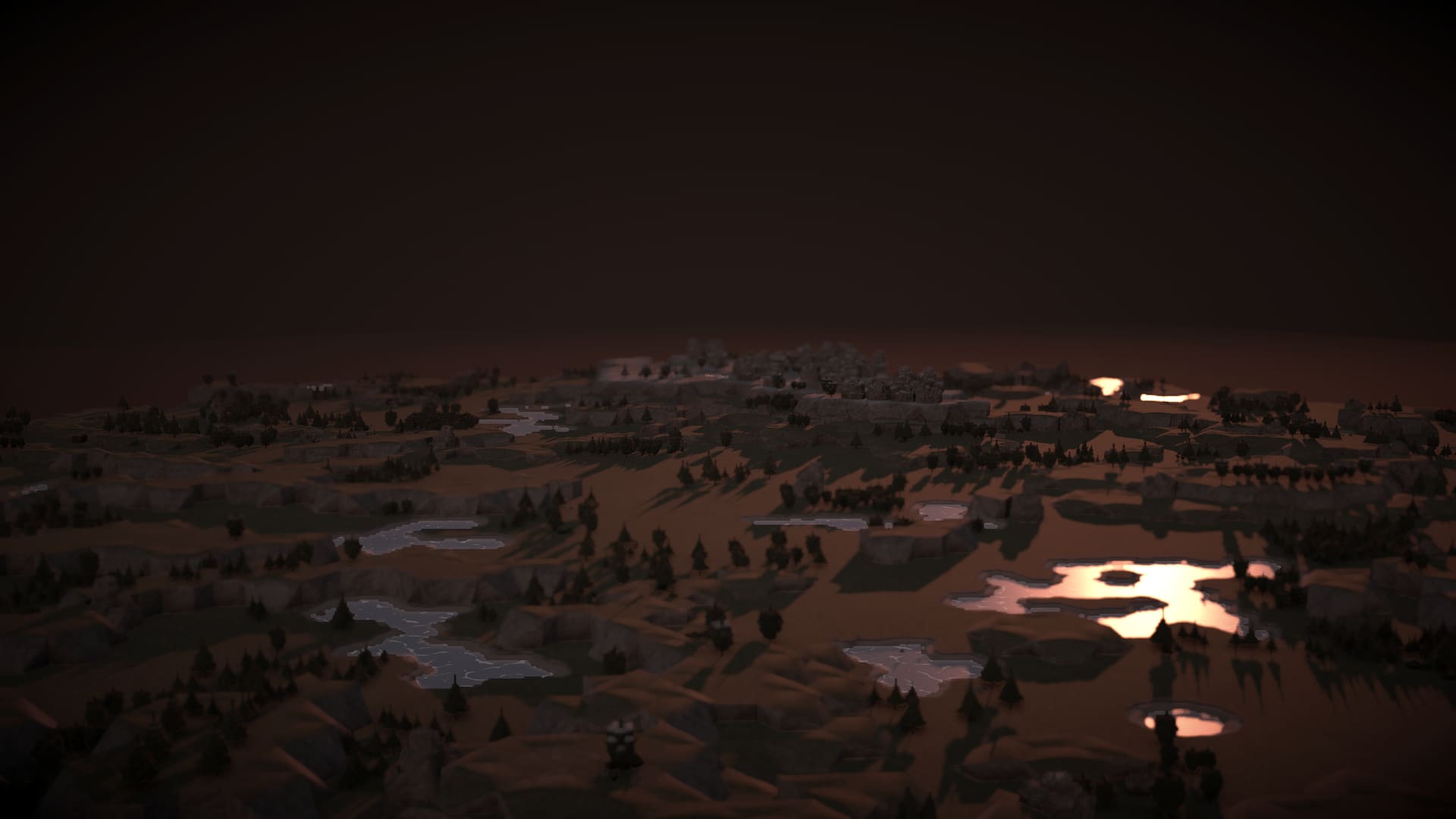
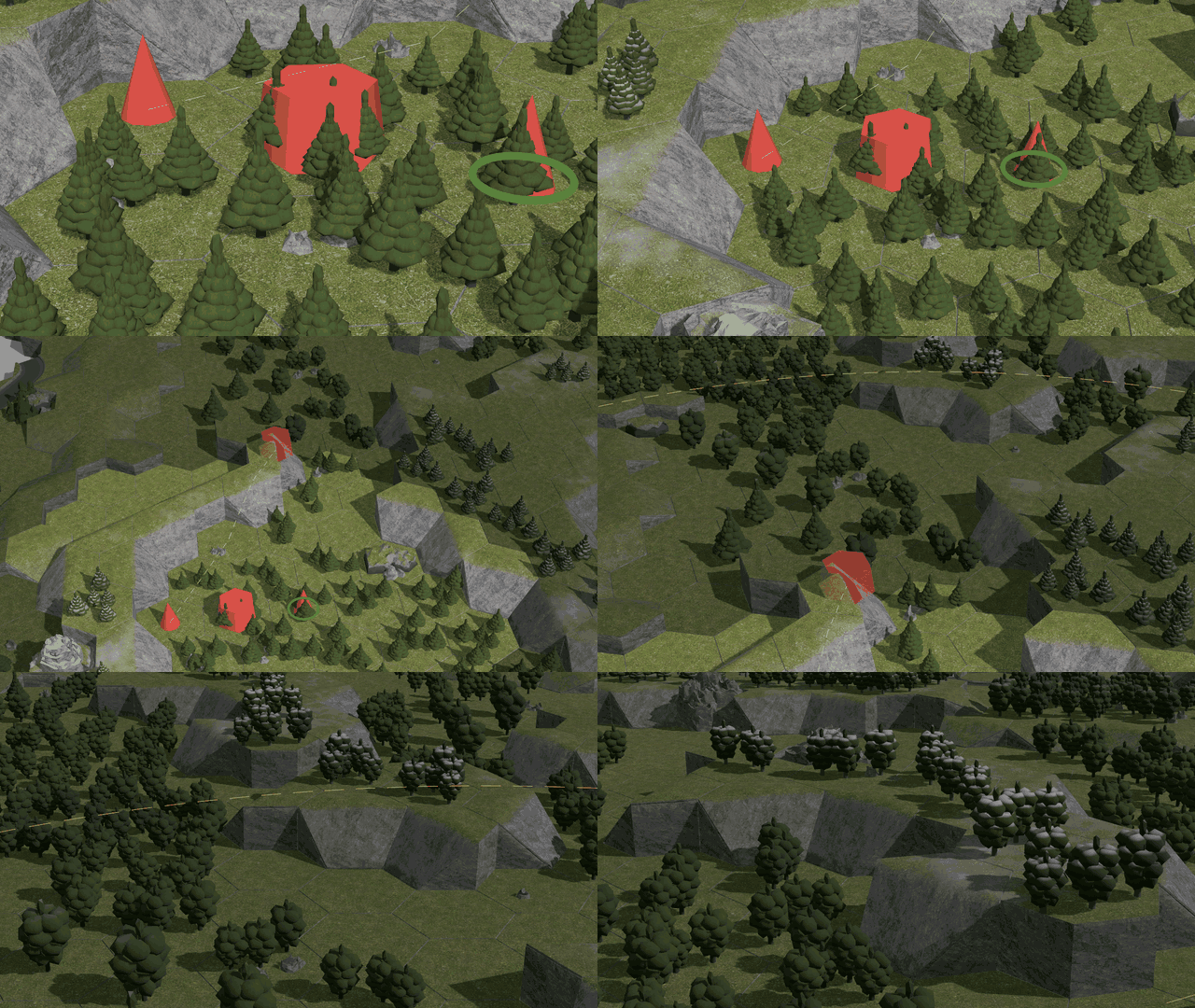
The arena is a hex map grown from a seed: ridges, forests, grassland, cold lakes and winding rivers. No two domes are alike. Nobody has solved this one.
Terrain is not scenery. It decides what a city can harvest, how fast a road can be laid and how far anyone can see. Lakes can’t be crossed, rivers need bridges, and a mountain ridge is a wall for your eyes as well as your feet.
High ground is power. Height extends what a city can see, and lets its guns reach further at a target below it. Height never adds damage. It adds reach, and reach is how you see an attack coming.
Fog of war hides everything you aren’t looking at. Terrain is public; what moves across it is not. You see what your cities, founders and caravans see, plus what a road lets you borrow from an enemy city.
Cities see the farthest, founders less, and a caravan only what is close around it.
02 / Founding
Claim ground and fight for it
You begin with a capital and two founders. The first day is the last time anyone is safe, and what you settle now you live with for weeks.
Your capital starts built: 15 soldiers, a Barracks, a University already humming, and a stockpile of 100 wood and 50 stone. Founders are scouts with a purpose. They walk anywhere, no roads required, at half a hex an hour. They also disband after 24 hours, which is only a modest walk, so you can’t send them across the world. Choose well and choose early.
Need more founders? Any city can build one for 120 wood and 80 stone, which takes two hours. Most players aim for about five cities each before the first contact. A new city takes an hour to build, undefended, then gets five soldiers.
Veteran’s note
Settle close to an enemy and you’ve built a front you can’t defend. Settle far from everyone and you’ve built a city nobody needs to hurry to take.
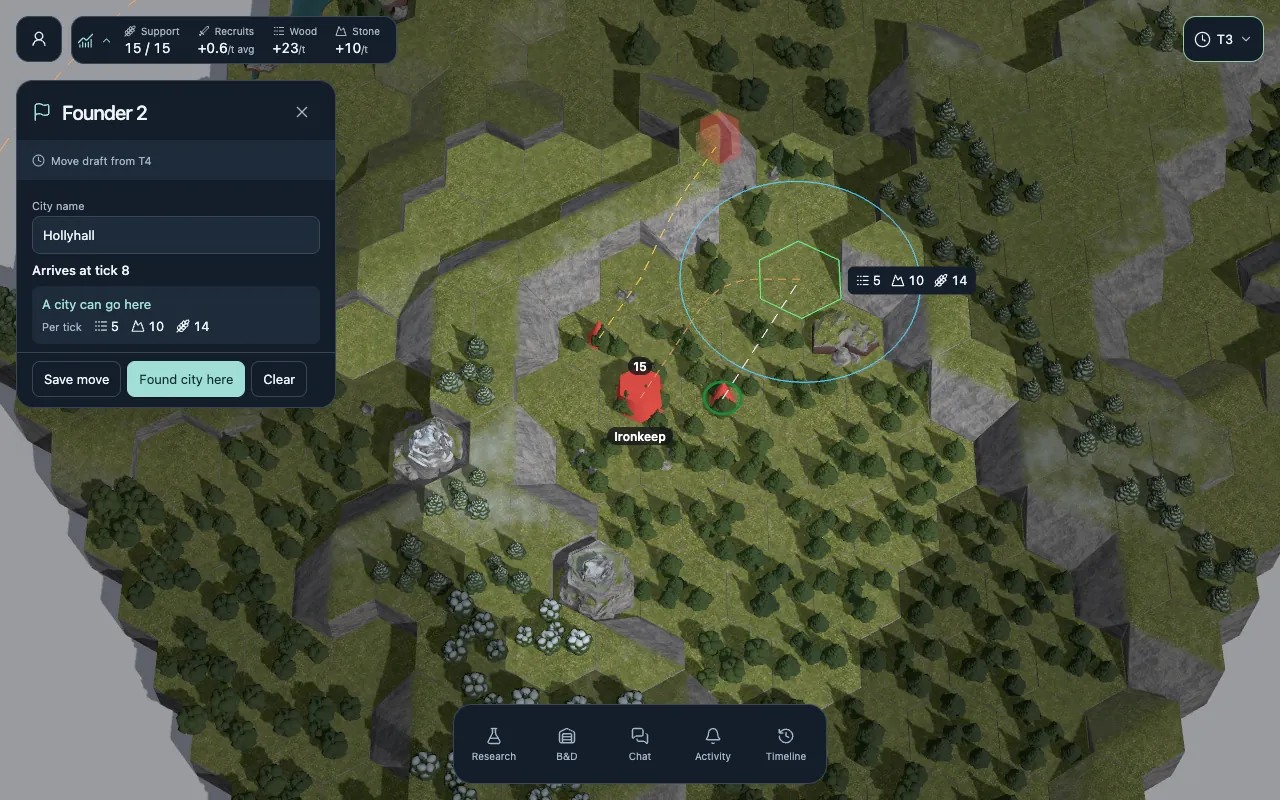
- A ticking clock. This founder reaches the site at tick 8 (a tick is an hour). Founders disband after 24 hours, so every trip has a deadline.
- The harvest ring. The city will gather from every cell inside this circle. Move the target and watch it change.
- Yield per hour. Wood, stone and food this exact spot would produce, after sharing with your other cities.
- Commit. Found the city here, or save the move and decide at the destination.
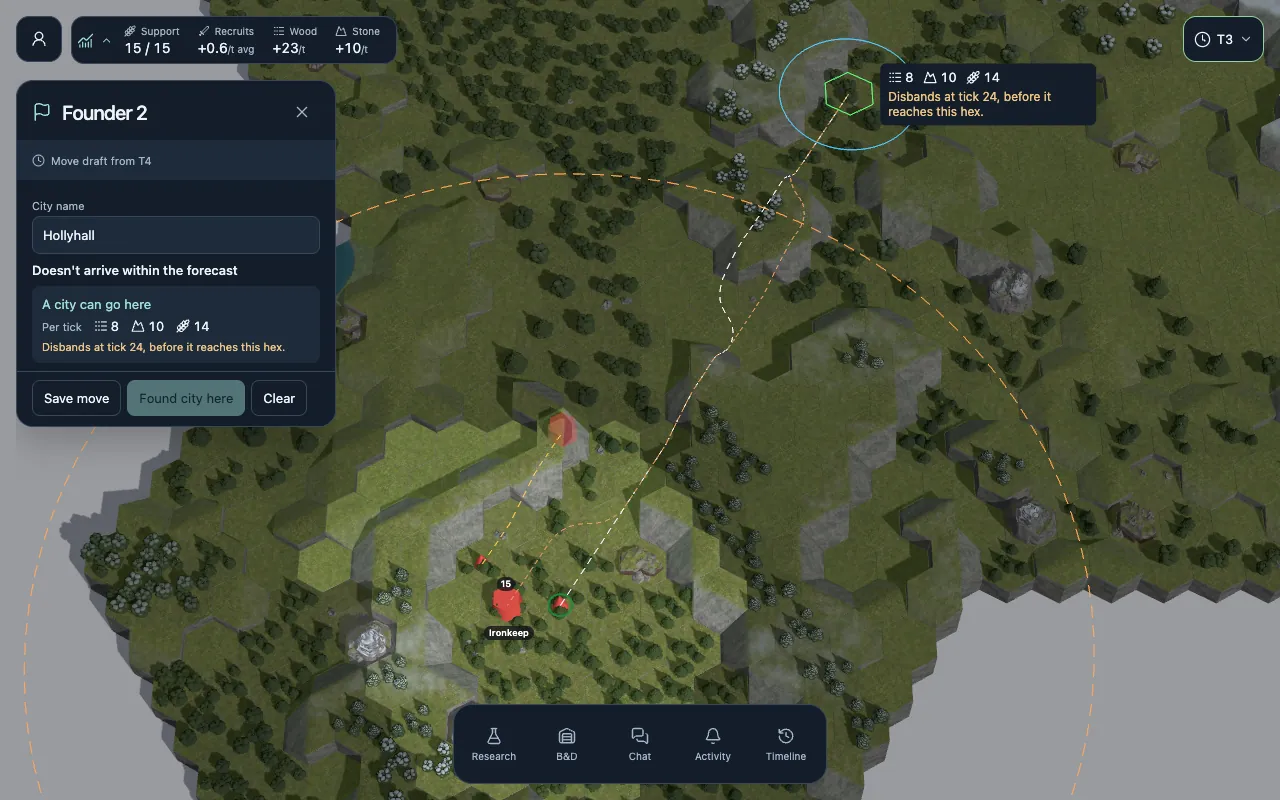
- Too far. A tempting spot beyond the ridge, but the game warns you the founder will disband before it arrives.
- The reach ring. The dashed line is the edge of what one founder can ever walk to.
03 / Resources
Three resources. Nothing is shared.
Wood and stone are real stuff in real cities. Food is not stuff at all. It is a limit.
Wood
Builds founders, caravans and upgrades.
Stone
The other half of nearly every price.
Food
Never stored. Sets how many soldiers you can field.
Every city harvests the ground inside its ring and drops the wood and stone into its own stockpile. There is no shared empire bank. A rich forest city can’t pay for anything in a quarry city until a caravan carries the materials over, and every hour a caravan is on the road is an hour somebody can see it. Cities with no road at all must live off what they make.
The ring grows when you research Economy, by half a hex a level. But rings that overlap share their yield equally between every city that reaches the ground, rivals included. Two cities on the same patch earn about half each. Spacing your cities isn’t etiquette, it’s income.
Food works differently. Each unit of food you produce each hour lets you support one soldier, counting every soldier you own, in a garrison or on a caravan. Hit the cap and recruitment stops until you grow it, by founding on better land or researching Agriculture. Soldiers over the cap aren’t lost, but you can’t raise more. Your army is only ever as big as your farmland.
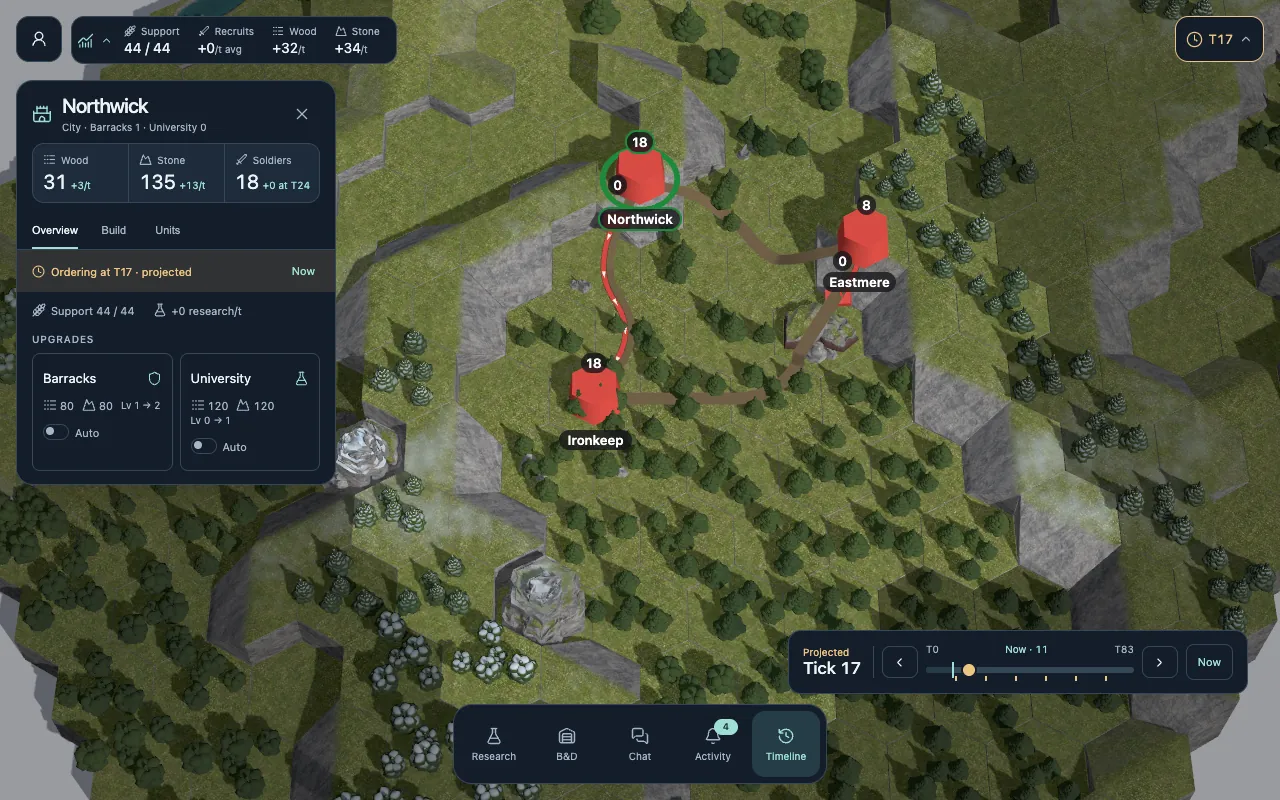
- Empire at a glance. Support (soldiers owned against what your food allows), recruits per hour, and total wood and stone income.
- This city’s stockpile. Wood and stone on hand with the hourly rate beside each, plus its garrison.
- Support. 44 soldiers against a cap of 44. At the limit, so the next batch won’t be raised until the farmland grows.
- Upgrades. Costs are paid from this city’s stockpile only.
04 / Cities and upgrades
Every city is a weapon. Choose what it becomes.
Two upgrades turn a city from a mine into a power: one makes soldiers, the other makes ideas.
Barracks raise how many soldiers a city recruits each cycle. A level costs 40 wood and 40 stone times the level you’re buying, so the third costs more than the second. Universities produce research points for the whole empire. The first costs 120 wood and 120 stone and each level after doubles it. Cities on high ground get a discount on Universities: 10% per level of height, up to half price. A mountain monastery is the cheapest brain in the dome.
Can’t keep up? Each building has an Auto toggle that buys the next level whenever the city can afford it, so stockpiles never sit idle in a city you forgot.
- Capital start
- Barracks 5University 3
- New city start
- Barracks 1University 0
- Caravan
- 20 wood, 10 stonebuilt in 1 hour
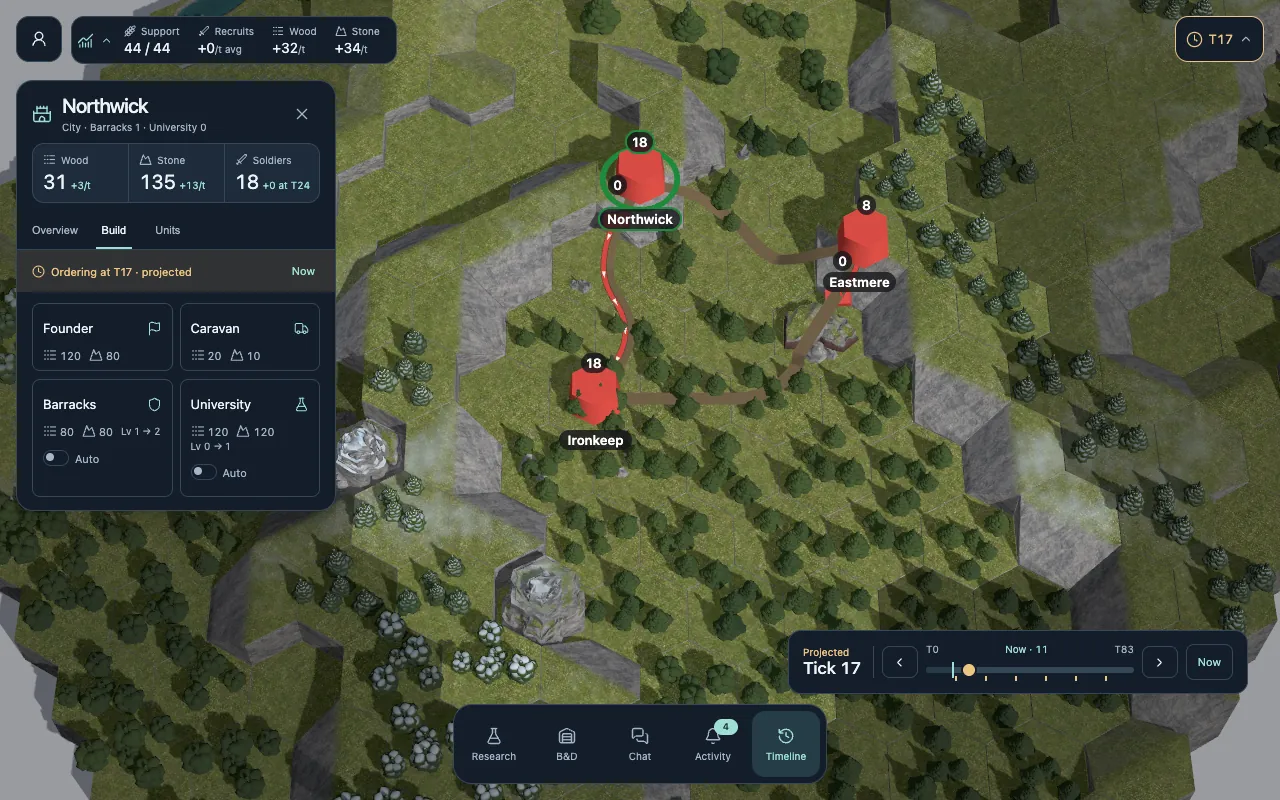
- Founder. 120 wood, 80 stone. Walks off-road to plant a new city.
- Caravan. 20 wood, 10 stone. Hauls soldiers and materials along roads.
- Barracks. Bigger recruiting batches. This one is going from level 1 to 2.
- University. Research points. 120 wood and 120 stone for the first level; cities on high ground pay less.
- Auto. Buy the next level automatically as soon as the stockpile allows.
05 / Soldiers
Everyone musters at the same hour. So does your enemy.
Every completed city recruits at the same moment, every twelve hours. Everyone’s soldiers appear together, which makes that moment the heartbeat of the war.
A city’s batch is its Barracks level times (Recruiting level plus two). Your capital, with Barracks 5 and Recruiting 1, raises 15 soldiers a cycle. A young city with Barracks 1 raises 3. Food caps the total: if your farms can’t support the whole batch, cities take turns, with a rotating order so the same city isn’t always the one left out.
The synchronised clock is a weapon. A city captured on a recruitment tick recruits for its new owner, and its defenders never see the batch. Everyone knows when the next muster is. Plan your arrivals around it.
- Cycle
- every 12 hoursall cities at once
- Batch
- Barracks × (Recruiting + 2)5 × 3 = 15 at the start
- Cap
- 1 soldier per foodAgriculture raises it
06 / Roads and caravans
You don’t build roads. Your cities do. So do theirs.
A road is a handshake and a knife. It carries your soldiers to the front, and it carries theirs to your door.
Every city has a reach, which starts modest and grows over the city’s first week. When another city falls inside that reach, measured in terrain cost and not in straight lines, a road is laid between them, in an hour if you own both and two if you don’t. Forest is slower to cut through than grass, a ridge slower than either, a river means a bridge, and a lake means going around. This applies to enemy cities too. You don’t choose your neighbours’ roads, only how close you build.
Roads run strictly from one city to another. There are no junctions, and roads that merely cross connect nothing. A caravan on a road must stop at every city along it. Found a new city within two hexes of a road and it bends the road through itself, enemy roads included, which is one of the sneakier ways to change the map.
Caravans are how everything moves. A caravan carries soldiers, wood and stone together. You give it a route with a series of stops, and at each stop you choose, separately for soldiers, wood and stone, whether to pick up or drop off, and how much: all, a fixed number, or “leave at least N behind.” Set it to loop and it will ferry stone to your capital forever. It travels at half a hex an hour. Once it leaves for a stop it cannot be turned around, though the route beyond that stop can still change.
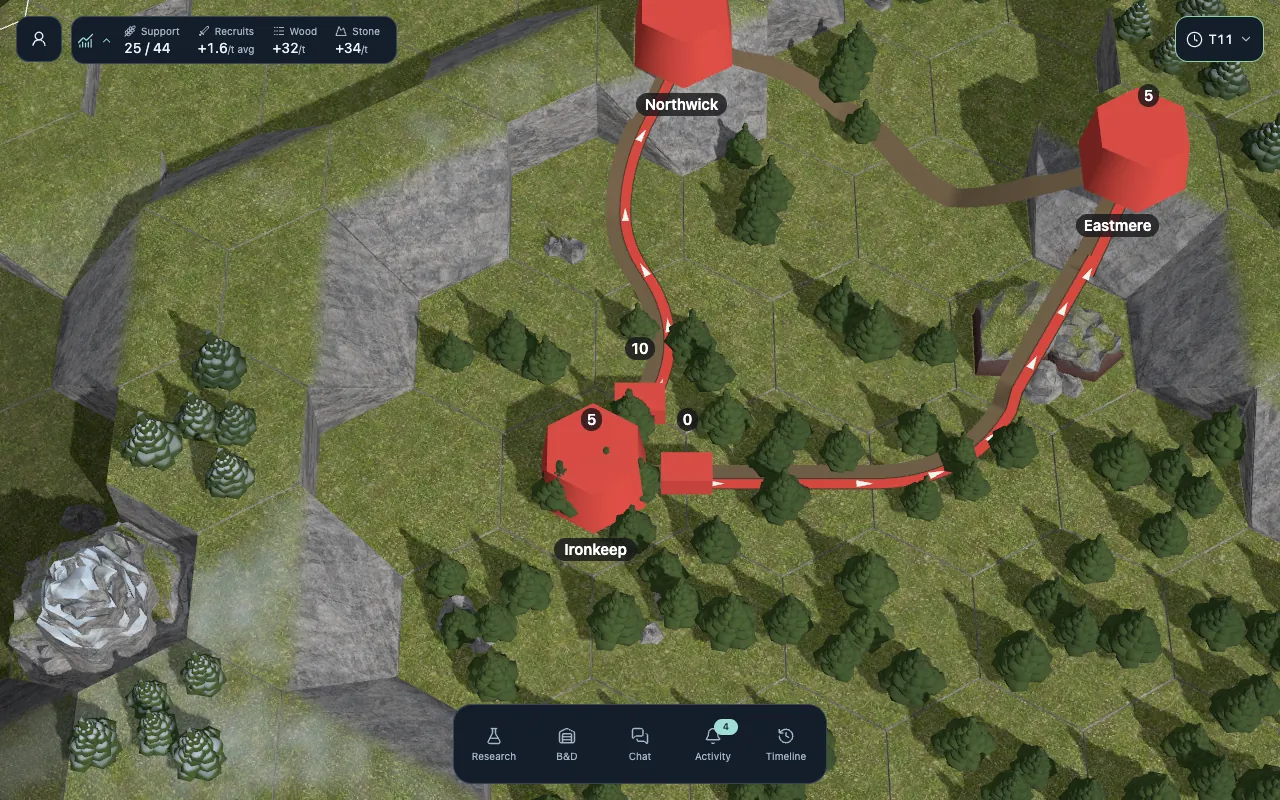
- Garrison. The number on a city is the soldiers inside it.
- A loaded caravan. Ten soldiers are aboard and bound for the northern city.
- A route in motion. The red path and arrows are a caravan’s whole planned route, including the leg it hasn’t started.
- A mandatory stop. Roads end at cities. Nothing leaves a road in between.
07 / Battle
No dice. Only arithmetic.
If you know the numbers on both sides, you know who wins. There is no luck to blame. That’s why the fight is won in the weeks before it.
1. Approach fire
A caravan marching on a city is shot at on the way in. Each hour the garrison deals damage equal to 5% of its soldiers, split between whatever it can see in range. The caravan fires back at 2% of its soldiers. A city outreaches a caravan, and high ground stretches that reach further. Everything depends on line of sight, which is why ridges and hills matter.
2. Contact
Hostile caravans that meet on a road stop and fight where they meet. Ambushes are real. If you see an enemy caravan leave, you know roughly where it will be, and when.
3. The decisive battle
When the survivors reach the walls the battle is decided in a single tick. The defender strikes first. Each strike removes soldiers equal to the striker’s Weapons level, and a defending city adds one to that. Sides alternate until one has nobody left. That’s it. Casualties are shared equally between every caravan on a side.
4. Capture
The winner takes the city, its stockpile, and a loot bonus drawn from its recent production (a city that has only just changed hands is worth little). The old owner’s pending orders for it are cancelled. And remember the recruitment clock from the last chapter.
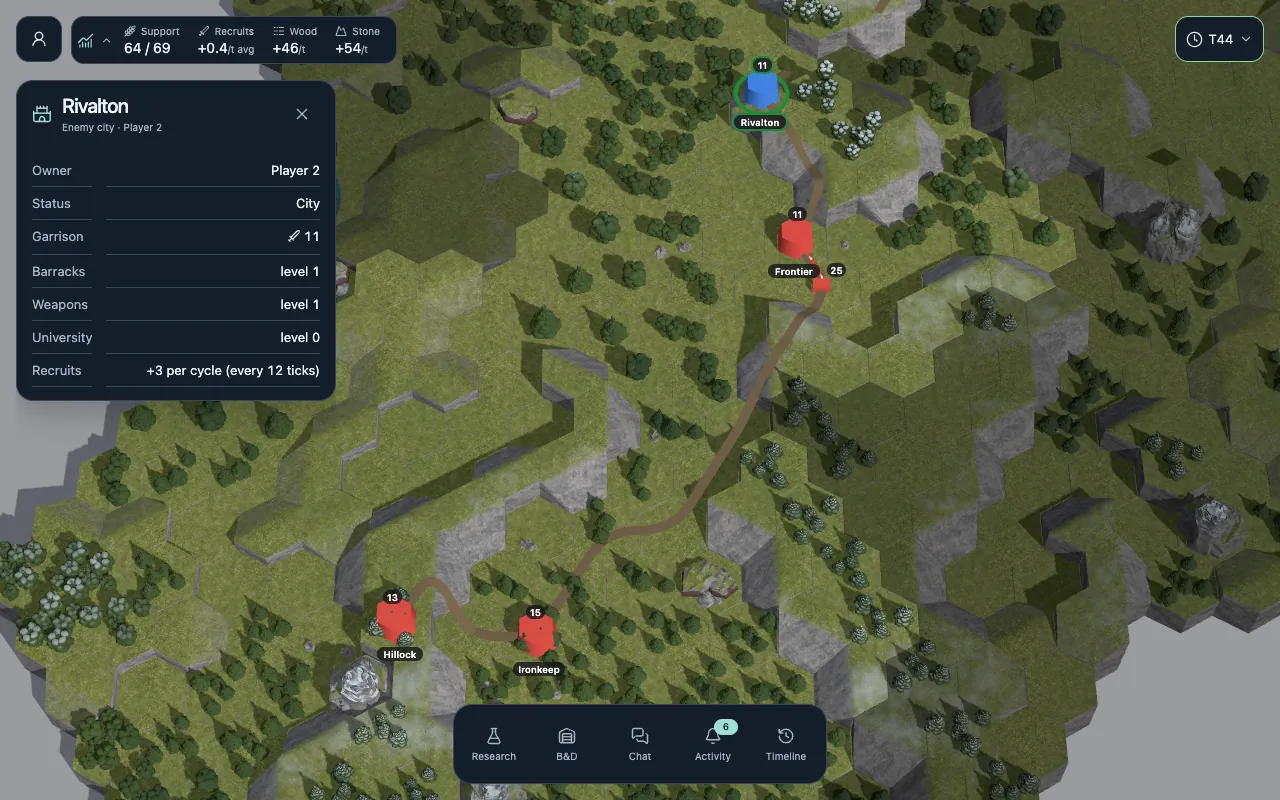
- The target. A rival city, connected to yours by road.
- Its garrison. Exactly how many soldiers are inside, right now.
- Its growth. Barracks, Weapons and its next batch, so you can predict the garrison at the hour you’ll arrive.
- Your caravan. Parked beside Frontier with 25 soldiers aboard. Is that enough?
Roads cut both ways
A completed road to an enemy city shows you what the city sees and lays its soldier count and upgrades bare. Assume they are reading you the same way.
08 / Research
Six ways to get ahead. None of them cheap.
Universities turn stone and patience into points. Points turn into technology that applies to every city you own.
Every University produces points each hour equal to its level times (your Research level plus two). Your capital begins with University 3, so you start earning 9 points an hour. A level costs 250 points times its own square: 250 to reach level 2, 1,000 for level 3, 2,250 for level 4. The first jump lands about a day in. By the time you’re trading blows, every level will have been a choice.
- Weapons
- +1 casualtyper strike in battle
- Economy
- +½ hexharvest ring
- Recruiting
- +1 soldierper Barracks level a cycle
- Research
- +1 pointper University level
- Logistics
- +5% speedfor caravans
- Agriculture
- +10% foodsupport per level
You research one thing at a time and can queue the next. Switch subject mid-level and the unfinished progress is lost, so decide before you start. Completed levels are permanent.
The sharpest idea in the tech tree isn’t on it. You can buy a technology shipment for a level you already have, load it on a caravan, and drive it to an ally. That ally gains one level when it arrives and unloads. It can also be stolen, so every shipment is an escort mission waiting to go wrong.
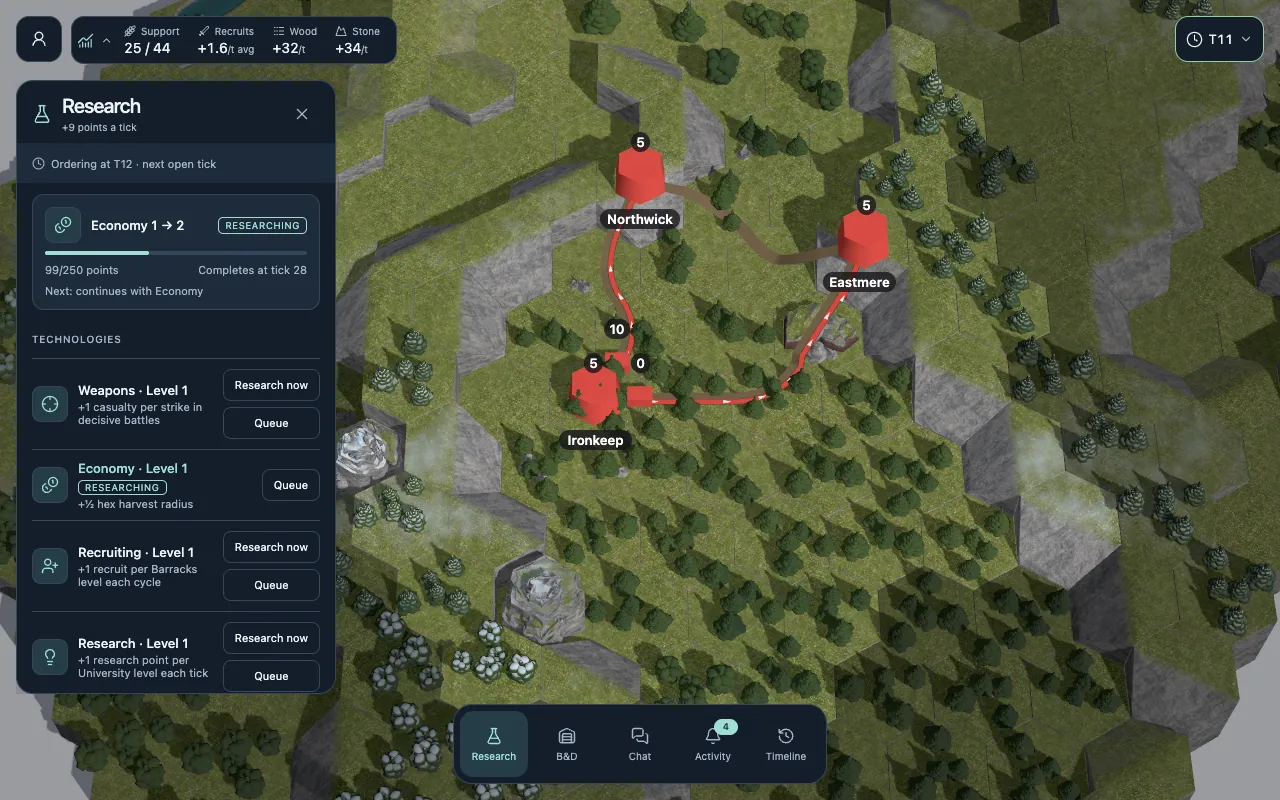
- Your output. Nine points an hour from the capital’s University.
- The current subject. Economy, level 1 to 2.
- The ETA. 99 of 250 points. It finishes at tick 28 unless something changes.
- Choose or queue. Research something now, or line it up next.
09 / Time and planning
Scrub the future. Then commit to it.
The clock never stops, but it ticks once an hour. You can play the game in a few minutes at a time, and see most of what’s coming.
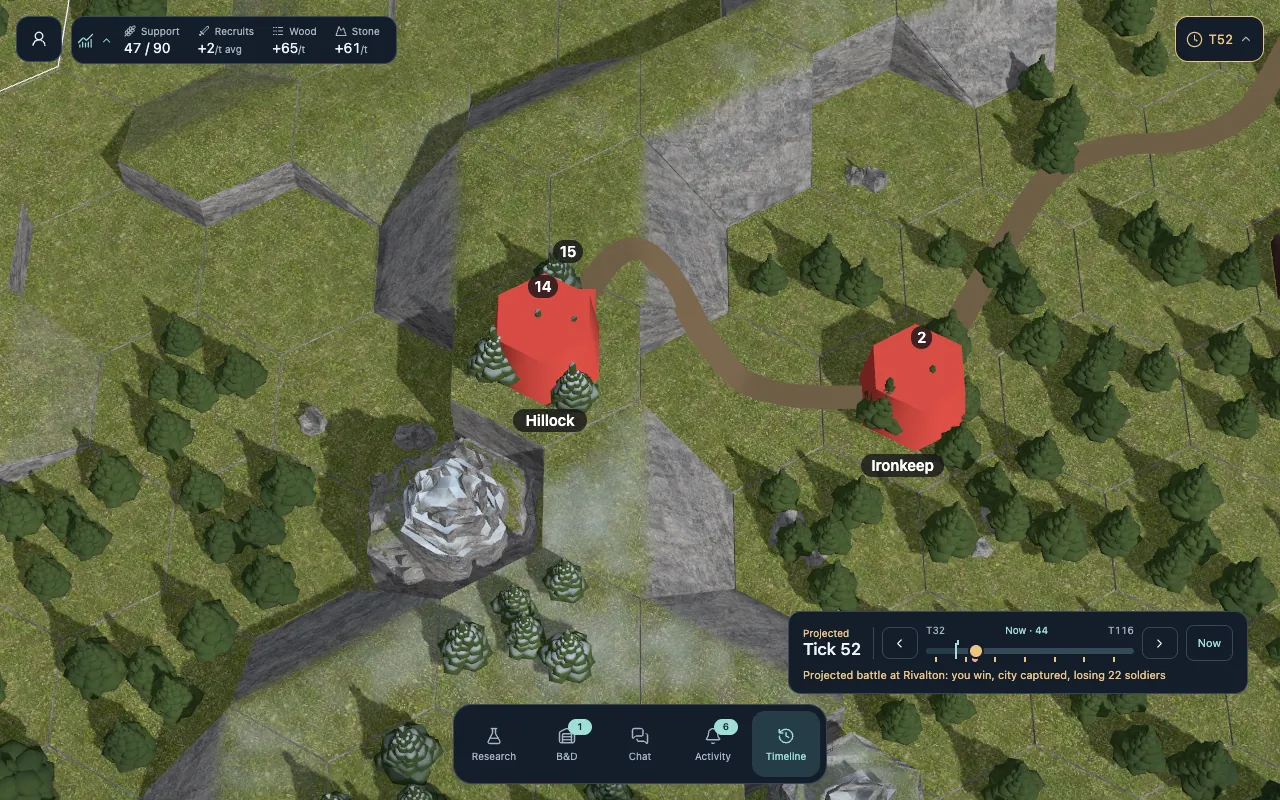
The time wheel lets you slide forward up to three days, and back half a day to review what happened. As you scrub, caravans glide along their routes, stockpiles fill and drain, soldiers appear at the next muster, and battles that are coming, and who wins them, show up in the corner of the screen.
You issue orders in the future you’re looking at. Scrub to the hour your caravan arrives, tell it to unload half its soldiers, build a second caravan with what’s there, send both on. Each order is saved for its tick and fires then, whether you’re at your desk or asleep. A real general with a plan and a night’s rest is one of the strongest things in the dome.
Early days, late days
For the first day or so, checking in more often gets you very little. Later, when armies are marching and rivals are circling, every hour you’re paying attention is an hour of advantage.
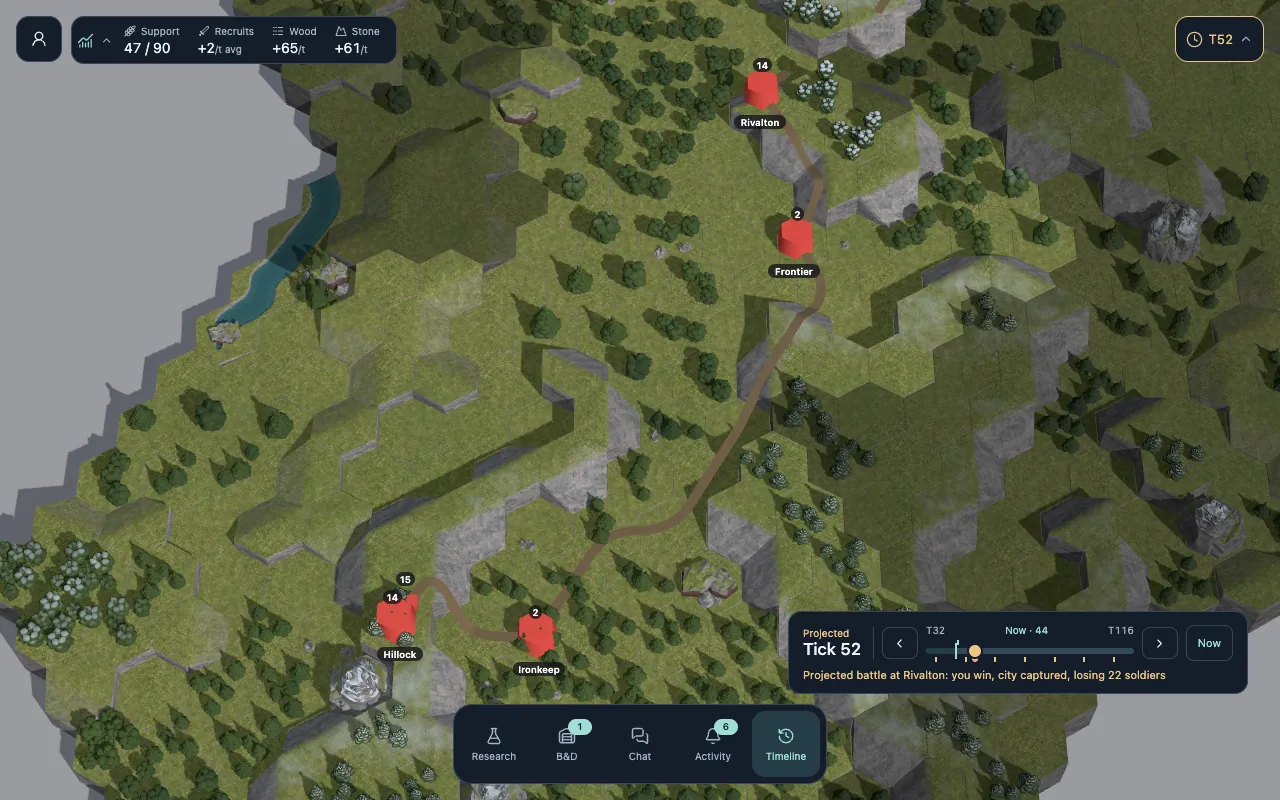
- The wheel. Eight ticks ahead of “now.” Everything on the map is the projected future.
- The forecast. A battle at Rivalton, the result, and the price in soldiers.
- The prize. The city you’re about to take, already in your colours in the future you’re looking at.
10 / Diplomacy
Diplomacy
The most dangerous road in the dome is the one that leads to your ally.
Matches are won on the map and half won in the chat. You can talk to the other players, trade, and propose alliances, which the other side has to accept. Allies share what they see. Their soldiers never fight yours, and can pass through each other’s territory. Alliances are between two players only. Your ally’s ally is not yours.
Allies can gift stone and wood by caravan, and send each other technology. But nothing in the rules binds anyone to anything. An alliance is a promise, and the dome keeps no record of promises. When allied armies attack the same city together, the player who finishes with the most soldiers takes it, even if the enemy was the other one’s idea.
No amount of real money buys any combat advantage, ever. The only currencies are time, attention and trust.
11 / Victory
Two ways this ends
Be the last general standing, or own almost everything for a full day while the whole dome tries to stop you.
- Last one standing
- Everyone else defeatedor surrendered
- Land control
- 90% of hexesheld for 24 hours
- Quiet too long
- Seat surrendersafter 36 hours away
Land control. Every hex on the map belongs to the completed city nearest to it. A hex equally close to two rival cities belongs to neither. Hold 90% for a full day and you win. Everyone is told the moment the countdown starts, and told again if it breaks. A winning position is also the loudest alarm in the match.
Elimination. Losing your capital does not eliminate you. You’re out only when you have no cities, no founders and no caravans left, and even an empty caravan, creeping down a lonely road, keeps you in the war. Nobody is dead until the last wheel stops turning.
You can surrender whenever you like. A seat nobody opens for long enough surrenders for itself, and its cities sit passive on the map, defending themselves but going nowhere. Early leads are never guarantees. Better weapons, a well-timed alliance, or an attack from two sides at once can topple the front-runner.
How it begins
Your first day, hour by hour. It’s the easy one.
Every match writes its own story, but they all begin about like this. Times are ticks, which are hours.
-
Look before you leap
You have a capital, two founders, 15 soldiers, 100 wood and 50 stone. Open placement mode, read the harvest rings, choose where your first two cities will go and send the founders off. They have 24 hours to live.
-
Two flags go up
Each city takes an hour to build and sits undefended while it does. Then five soldiers move in and the city starts to grow roads toward the capital.
-
The first muster
Every city recruits at once. The capital raises 15. A new city raises 3. Your support number rises or caps out. Now you know how much farmland you really need.
-
Reach for five
Fill out your corner of the dome. Roads knit the cities together. Caravans ferry soldiers where they’re needed. And somewhere out in the fog, a road begins to grow toward somebody else.
-
Contact
A road finishes. A garrison number appears that isn’t yours. The fog pulls back. From here, it’s a long game of arithmetic, arrival times, and who you can bring to your side.
Learned the hard way
What the survivors will tell you
- Space your cities. Overlapping rings split their yield, rivals included. Two cities side by side earn about what one would.
- Read every road. A road shows you a rival’s garrison, Barracks and Weapons. Know what you’re walking into before you send anyone.
- Plan before you sleep. Scrub the wheel through the night, queue your orders and let them fire while you rest.
- Trust slowly. Allies share your sight, and a good friend knows exactly where your weak cities are.
Disclaimer: the screenshots on this page use beta assets from the game in development, and the art, interface and layout are all subject to change. Numbers are alpha balance settings and will change as we playtest. All cities, names and positions are test data.
The dome is sealed for now. We’ll tell you when the gates open.